
 English
 عربى
عربى
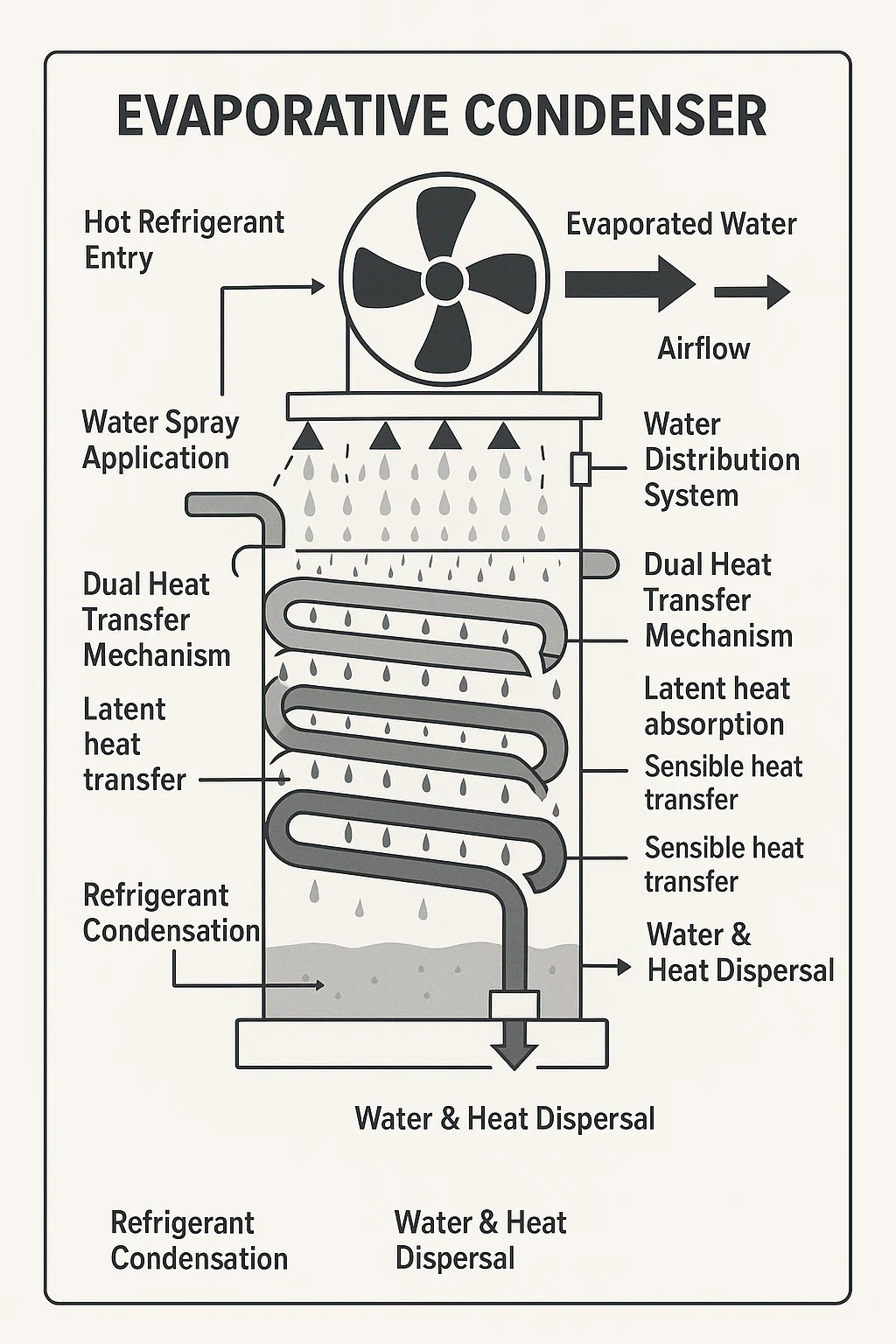
Below is a technical breakdown of how evaporative condensers work:
Content
■Core Working Principle
Evaporative condensers reject heat by combining air cooling with water evaporation. Unlike standard condensers relying solely on sensible heat transfer, they leverage latent heat absorption during water evaporation.
■Step-by-Step Operation
▸Hot Refrigerant Entry
Hot, high-pressure vapor from the compressor enters the condenser’s coiled tubing.
▸Water Spray Application
A pump sprays water continuously over the exterior of the refrigerant coils.
Water coats tubing surfaces, forming a thin film.
▸Forced Airflow Interaction
Fans pull ambient air through the wet coil bundle.
Airflow accelerates evaporation of water film on the coils.
▸Dual Heat Transfer Mechanism
Latent heat absorption: Energy from the refrigerant vapor transfers to water, causing evaporation.
Sensible heat transfer: Airflow carries away residual heat from refrigerant and unevaporated water.
▸Refrigerant Condensation
Heat loss causes refrigerant vapor to condense into high-pressure liquid inside coils.
▸Water & Heat Dispersal
Evaporated water exits as vapor in exhaust air.
Unevaporated water collects in a sump for recirculation.
■Key System Components
Coil Bundle: Refrigerant-containing tubes (copper/stainless steel).
Water Distribution System: Spray nozzles, pumps, and sump tank.
Fans: Induced-draft (top-mounted) or forced-draft (side-mounted).
Drift Eliminators: Prevent water droplets escaping with exhaust air.
■Critical Efficiency Factors
▸Wet-Bulb Temperature Dependence
Condensing temperature approaches ambient wet-bulb temp (not dry-bulb), enabling lower head pressure than air-cooled units.
▸Water Quality Management
Scaling from hard water reduces heat transfer – demands chemical treatment/softening.
Bleed-off valves control mineral concentration.
▸Freeze Protection
Glycol additives or drain-down systems prevent winter ice damage.
■Real-World Failure Modes
▸Neglected Maintenance Consequences
Clogged nozzles → Uneven water distribution → Dry spots → Refrigerant overheating.
Scale buildup → Insulated tubing → 30%+ efficiency loss.
Legionella growth in untreated water sumps.
▸Airflow Restrictions
Dust/debris blocking coils or fan blades → Reduced evaporation → Compressor overload.
▸Why This Isn't an "Evaporator"
Evaporators absorb heat (e.g., indoor AC coil).
Evaporative condensers reject heat (outdoor function).